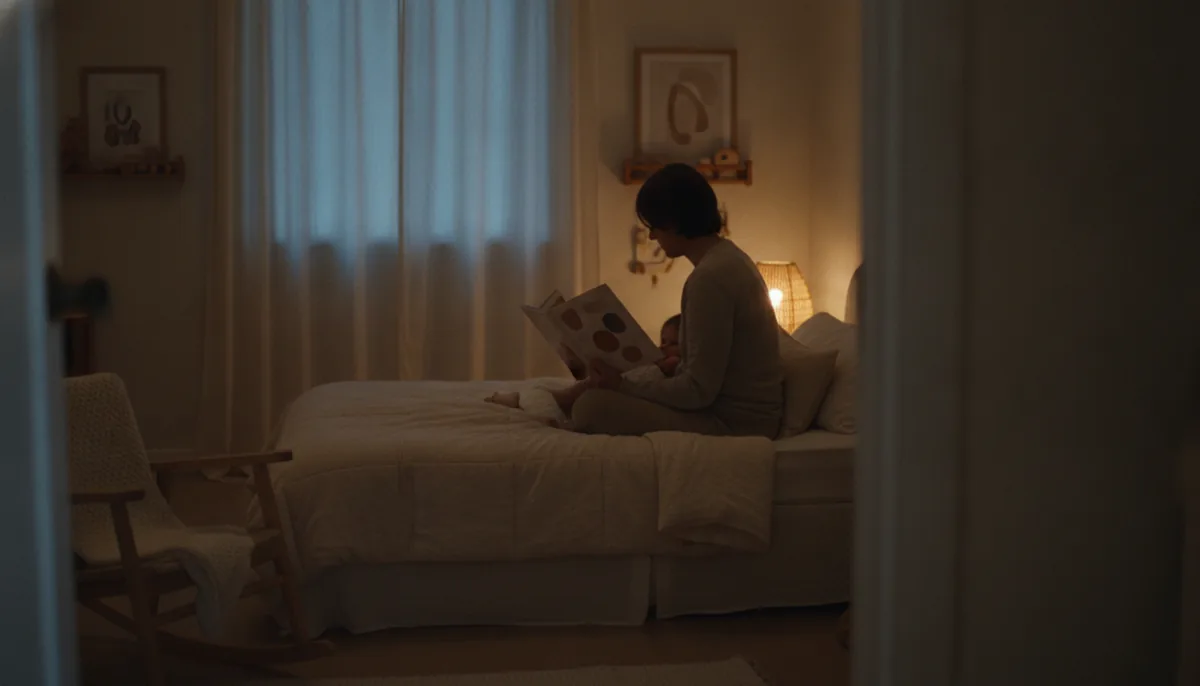
Parenting advice tends to be expensive, contradictory, or both. There are courses, apps, devices, and opinions. And then there is this: sit down with your child every evening, in the same place, and read aloud for ten minutes. No equipment beyond a book. No technique to master. The only hard part is the word "every", and even that turns out to be more forgiving than it sounds.
We have built and rebuilt this ritual through travel, illness, new siblings and lost favorite books. What follows is the case for it, and the survival manual.
Why "boring" is the feature
A good bedtime reading ritual is, from the outside, almost comically dull. Same time, give or take. Same place: the bed, the corner of the sofa, the one chair that fits two people. Often the same opening line, said the same way: "Okay. Which one tonight?" Adults instinctively want to vary things, because variety is what keeps us interested. The ritual works for the opposite reason.
Predictability is the signal. When the lamp goes on and the familiar sentence is spoken, a child's body starts winding down before the first page is turned, the way yours relaxes when you sink into your usual seat on a long train ride. The ritual is doing the heavy lifting; the book is almost interchangeable. A child who knows exactly what the next ten minutes hold can stop negotiating, stop scanning, and just listen.
This is also why the ritual matters more than the book. A mediocre book inside a solid ritual still ends the day well. A wonderful book read at random times, in random places, by a parent checking the clock, does not.
The book can change every night. The lamp, the spot and the opening line should not.
What it quietly builds
The obvious gain is language. A child who is read to hears words, sentence shapes and ways of saying things that everyday kitchen conversation never produces. Nobody says "the moon rose over the meadow" while unloading the dishwasher. Books do, nightly, and children absorb it without anyone calling it learning.
The less obvious gain is the association itself. For a child with a bedtime ritual, reading means warmth: a shoulder, a low light, a parent's full attention at the exact hour when attention is scarcest. For a child who first meets books seriously in a classroom, reading can mean performance and correction. Both children learn to read. They do not arrive at first grade with the same feelings about it, and feelings about reading are stubborn things. They tend to outlast the phonics.
And there is the closeness, which deserves to be named plainly. Ten minutes where nobody is being hurried, corrected or organized is rare in a family day. The ritual builds that in, every evening, on schedule. Children notice. So, eventually, do parents.
Surviving the exhausted days
Here is where most rituals die: not from doubt, but from Tuesday. You are wrecked, the child is wired, and the inner voice says "skip it tonight, it won't matter." The trick is to make the ritual smaller instead of skipping it, because the streak is the asset.
Short books count. The Going to Bed Book takes two minutes and is a complete experience; so is Goodnight Moon, which was practically engineered for a parent running on fumes. Retelling counts too: lights low, book shut, "tell me what happened to the frog again." Even a two-minute version keeps the chain intact, and the chain is what tells your child this happens no matter what kind of day it was.
A word on audiobooks, since every tired parent eventually wonders. Audio is not a sin. It is wonderful for car rides and quiet afternoons. But it is a different thing than a voice plus a warm shoulder, and children know the difference immediately. Use audio as an addition, not as the ritual's understudy. The understudy, on truly broken evenings, is the two-minute version.
As they grow
The ritual does not end; it molts. Board books give way to picture books, and picture books eventually give way to first chapter books read in installments — a development children experience as a promotion. Something like Frog and Toad sits beautifully on the bridge: short chapters, real warmth, and a cliffhanger mild enough for 7 p.m.
The common mistake is retiring the ritual the day a child learns to read alone. Reading to yourself at six is work; being read to is rest, and a six-year-old has usually earned some rest by evening. Reading aloud also lets you offer books a notch above their solo level, which is where the good vocabulary lives. Many families keep reading aloud until age nine or ten, and stop only when the child, not the calendar, says so. Some never quite stop. There are worse fates.
The minimal ritual recipe
Four decisions, made once:
1. Time: a fixed slot, anchored to the routine ("after teeth"), not to the clock.
2. Place: one spot, always the same. The spot does half the work.
3. Opening line: one sentence that starts it every night, word for word.
4. Length: ten minutes as the standard, two minutes as the emergency floor. Skipping is the only failure mode.
That is the entire system. It is unimpressive on any single evening and remarkable after a year, which is the general shape of every habit worth having.
If the missing piece is the book rather than the ritual, our Book Finder asks three questions and suggests titles that have survived many of these ten-minute slots at our place, on good evenings and broken ones alike.
Transparency: some links on this site are affiliate links, marked with *. If you buy through them, we earn a small commission at no extra cost to you. Book titles mentioned in the text are recommendations we stand behind, whether or not a link is attached.