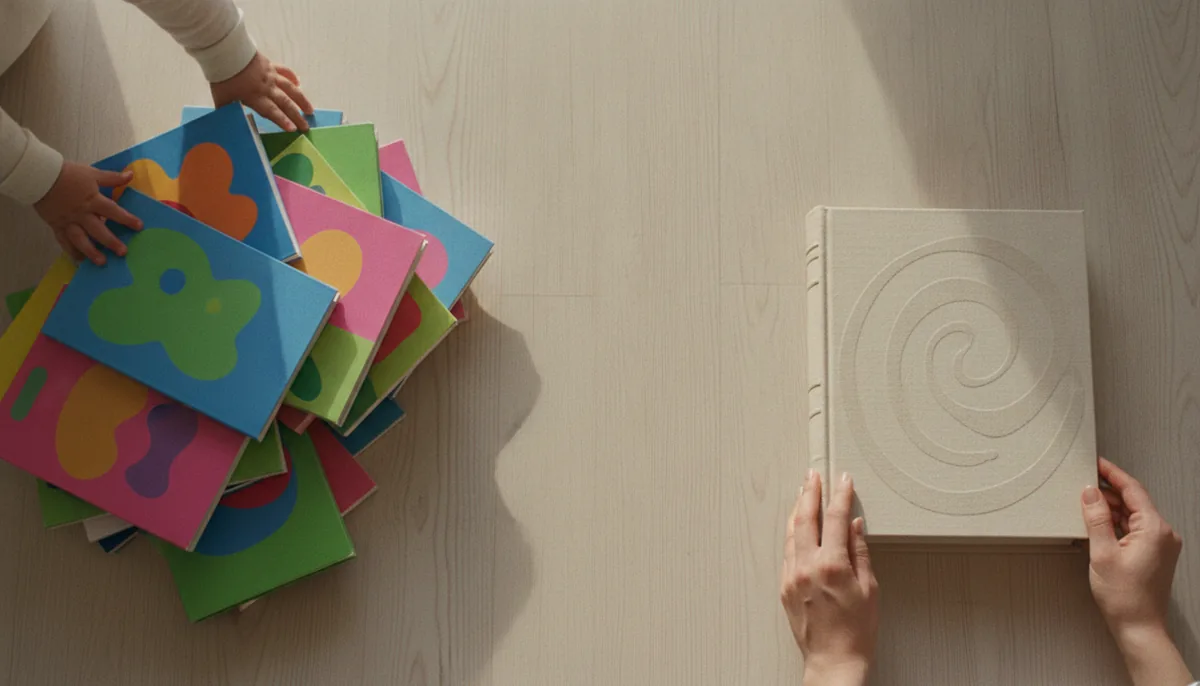
A children's book costs ten to fifteen euros, which is not the problem. The problem is what happens after: a bad book either gets requested every night, in which case you suffer, or it sits untouched on the shelf for two years, in which case it sulks at you. Either way, you paid for it twice.
The good news is that bad children's books are rarely subtle. They share a handful of habits, and once you can name them, you spot them in the shop in about half a minute. Here are the five we check every time.
1. The license logo does the heavy lifting
If the biggest thing on the cover is a TV or movie logo, you are usually not holding a story. You are holding merchandise that happens to have pages. These books are typically written by committee, on deadline, by people whose actual brief is to keep the brand warm until the next season airs. The plot exists to remind your child that the characters exist, which is another way of saying the book is an advertisement you read aloud.
There are exceptions, and your child's love for a franchise is real and allowed. But notice what the cover leads with. When the license logo is enormous and the author's name is missing or microscopic, the publisher has told you exactly where the effort went.
2. Tortured rhyme
Rhyming texts are wonderful when the rhyme carries the sentence. They are miserable when the sentence is bent backwards to reach the rhyme: "Into the woods went the bear so brown, upon his head a leafy crown." No one speaks like that, and no one reads it aloud without bracing first.
The test is mercilessly simple. Read four lines half-aloud, right there between the shelves. If the word order feels like furniture pushed against the wrong wall, put the book back. A stumble in the shop becomes a nightly stumble, in the same spot, for months, and you will come to dread it the way you dread a loose stair.
3. The moral arrives with a mallet
Flip to the last page first. If it ends with a sentence like "And so everyone learned that sharing makes us all happy", you have found the most common red flag in the genre. These books are not written for children. They are written for adults who want to have addressed a topic.
Children notice when they are being lectured, and they respond the way they respond to hidden vegetables: they find them, and then they stop trusting the cook.
The irony is that books without a stapled-on moral often teach more. The Day the Crayons Quit is, underneath the jokes, a book about fairness, being heard and finding compromise. It never says so. It is too busy being funny, which is exactly why children take its side of the argument seriously.
4. Pictures that merely repeat the text
Open a spread in the middle and compare. If the text says "Lena climbed the tree" and the picture shows, with great accuracy and nothing else, Lena climbing a tree, the illustrations are decoration. They give a child nothing to find on the fifth reading, and the fifth reading is precisely where picture books live or die.
In a good book, the pictures know things the words keep quiet. A detail in the background, a face that contradicts the sentence, a cat conducting its own subplot along the bottom edge. Julián Is a Mermaid goes further than most and lets the pictures carry nearly the whole story, which is why children return to it the way they return to a tide pool: there is always something moving in there that they missed.
5. A world from fifty years ago
This one is quieter than the others. Flip through and look at who appears: one shape of family, every grandparent frail, every mother at the stove, everyone resembling everyone else. No single book owes anyone a complete picture of the world. But books are one of the first places children learn what counts as normal, and they absorb that lesson without anyone reading it to them.
So the check is not ideological, it is practical: does this book's world have room in it for the actual people your child knows? The kids in their group, the families on your street, their own family? A shelf of books from one narrow world teaches a narrow lesson, every single night, in the gentlest possible voice.
The 30-second shop check
Five glances before you buy:
1. Cover: is the biggest thing a logo or an author's name?
2. Read four lines half-aloud. Does the word order fight you?
3. Last page: does it end in a lecture?
4. One middle spread: do the pictures add anything the text didn't say?
5. Flip through: does the book's world have room for your child's world?
None of this requires expertise, reviews or a phone. It requires thirty honest seconds and the willingness to put a charming cover back on the shelf. The first few times feel strict. After that it feels like a superpower, and your shelf at home quietly gets better.
And if you would rather start from books that already passed the check, our Book Finder asks three short questions and points you to titles we have read aloud more times than we can count, and still like.
Transparency: some links on this site are affiliate links, marked with *. If you buy through them, we earn a small commission at no extra cost to you. Book titles mentioned in the text are recommendations we stand behind, whether or not a link is attached.