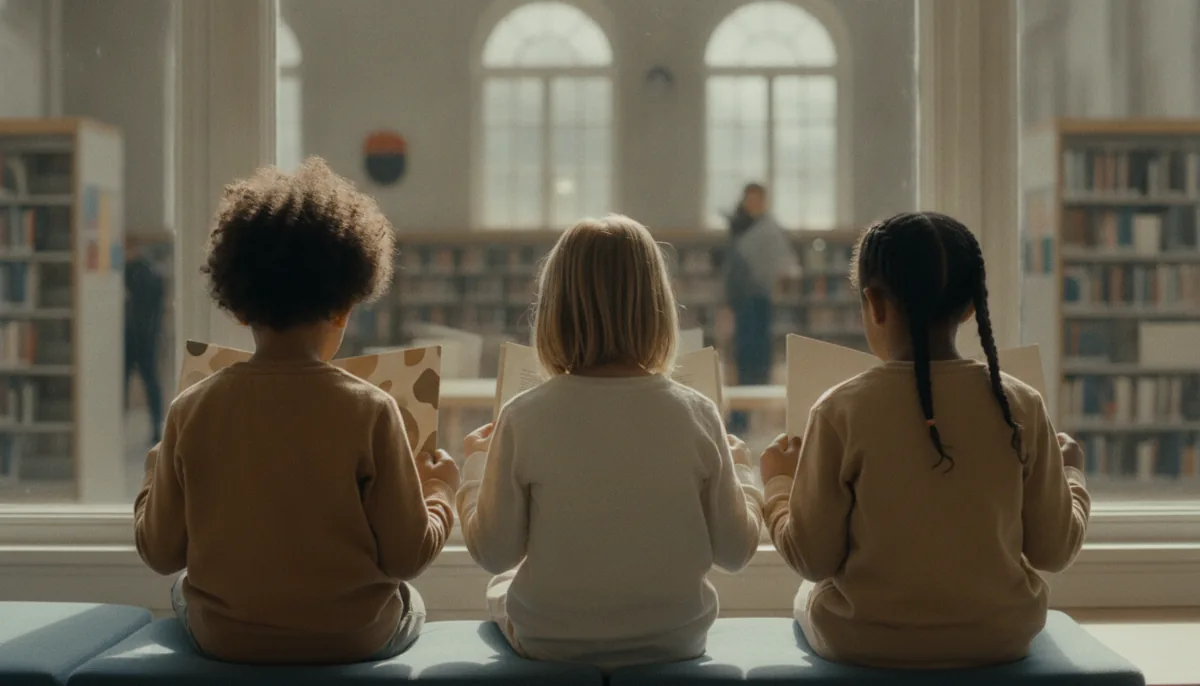
A picture book is one of the first windows a child gets onto how the world supposedly works. Not the moral on the last page, which children skip past anyway, but the furniture of the story: who drives the car, who stays home, who is allowed to be loud, who cries. Adults skim this. Children study it, on reading twelve, with the patience of archaeologists.
That makes the question of role models less ideological than it sounds. It is simply part of judging a book well, like checking whether the rhyme works or whether you will survive twenty bedtime readings.
The background cast
The interesting characters are rarely the heroes. They are everyone else: the parents in the doorway, the bus driver, the neighbor, the crowd at the market. This is where a book quietly answers questions nobody asked aloud. Who has the idea, and who carries the bags? Who comforts the crying child, and who reads the newspaper through it? Who fixes the bike, and who watches?
None of these images is a problem on its own. A mother at the stove is just a mother at the stove. The pattern is what teaches. If across the entire shelf the fathers are funny and absent, the mothers worried and aproned, the girls helpful and the boys loud, a child draws the obvious conclusion. Not because anyone told them to, but because that is what evidence looks like when you are four.
So when you flip through a new book, give the background two seconds. It usually talks more honestly than the blurb.
Children do not learn the lesson a book announces. They learn the world a book assumes.
Show, don't preach
The best modern books make a diverse world look unremarkable, because to children it is. In Last Stop on Market Street, a boy and his grandmother ride the bus through a city full of different lives, and the book never once points at any of them. The variety is just the weather of the story. In Julián Is a Mermaid, a boy's grandmother sees him dressed as a mermaid, and her acceptance arrives in a single wordless look. No speech, no lesson. That look does more work than any chapter of explanation could.
Compare that with the heavy-handed issue book, the one where every page nudges you in the ribs: see, everyone is different, and that is wonderful! Children smell the agenda instantly, the same way they smell hidden vegetables. Worse, the framing backfires. A book that treats difference as a Special Topic teaches that difference is special, which is the opposite of the point. The casual book says: this is normal. The earnest book says: this needs a whole book.
This is not an argument against books about hard subjects. It is an argument for craft. Story first, message wherever it lands.
Classics: keep, retire, or talk about it?
No, you do not need to purge the shelf. Most classics earned their place with rhythm, warmth and pictures that still work, and a childhood without them would be poorer. But they were written in their decades, and it shows: the mothers wave from kitchen windows, the doctors are all men, and some books contain words or caricatures that genuinely should not be read aloud unedited.
A practical sorting, no ceremony required. Keep: most of them, honestly. A book is not ruined because every parent in it wears an apron. Talk about it: some need one sentence of context, dropped casually mid-reading. "Funny, in this book only the dads drive. Grandma drives you to swimming, doesn't she?" That is the whole intervention. Children handle "this book is old" with remarkable ease. Retire: a few, where the problem is the heart of the book rather than its wallpaper. Those can move to the attic without a farewell ceremony, and nobody will miss them.
What you should not do is announce any of this. A lecture before a bedtime story teaches exactly one thing: that books come with lectures.
The 30-second check
You can do this in the shop or the library, with the same casual flip you would use to check the rhyme. You are not looking for a quota. You are looking for whether the book's world has more than one setting.
Flip through and ask:
1. Do girls make things happen, or do things happen to them?
2. Are boys allowed a feeling other than brave?
3. Do families come in more than one shape, even in the background?
4. Does anyone in the pictures look like your child's actual kindergarten group?
5. Bonus: who cooks, who drives, who has the idea, and is it ever the other one?
No book needs to pass all five. A book about a boy and his grandfather fishing does not fail because no girl appears, and a princess story is not disqualified by its castle. You are checking the shelf, not the individual title. If twenty books in a row answer the same way, that is worth noticing. If they don't, relax.
And that is really the spirit of the whole thing: this is not homework, and it is certainly nobody's culture war. It is the same quiet quality check you already do for language and pictures, extended to the world the book takes for granted. Thirty seconds, no flashcards, no speeches. If you want books that pass this check without trying, our Book Finder is a good place to start. The ones in there made diversity look like what it is at any playground: completely unremarkable.
Transparency: some links on this site are affiliate links, marked with *. If you buy through them, we earn a small commission at no extra cost to you. Book titles mentioned in the text are recommendations we stand behind, whether or not a link is attached.